




Why Combining AI Cameras and Proximity Warning Systems is the Ultimate Safety Solution
Industrial worksites are dynamic, fast-paced, and dangerous. For years, site managers across heavy industries have relied on automated safety technology to prevent devastating collisions between heavy industrial vehicles and pedestrian workers. Whether it is a forklift operating in tight aisles, an excavator swinging on a busy site, or a shovel loader handling bulk materials, managing the interaction between people and machinery is a constant challenge.
Discussing current trends in worksite safety, particularly person-to-vehicle safety, David Thomas, General Manager of ZoneSafe, stated,
“While traditional safety systems have saved lives, technology moves forward. The widespread commercial availability of artificial intelligence (AI) safety cameras is changing the risk-mitigation landscape. However, the new “Gold standard” of workplace safety does not lie in choosing one technology over another, but in fusing them into an integrated ecosystem. By looking at how standalone AI cameras stack up against traditional proximity warning systems, it becomes clear why combining them creates the ultimate protection for heavy plant industry sectors.”
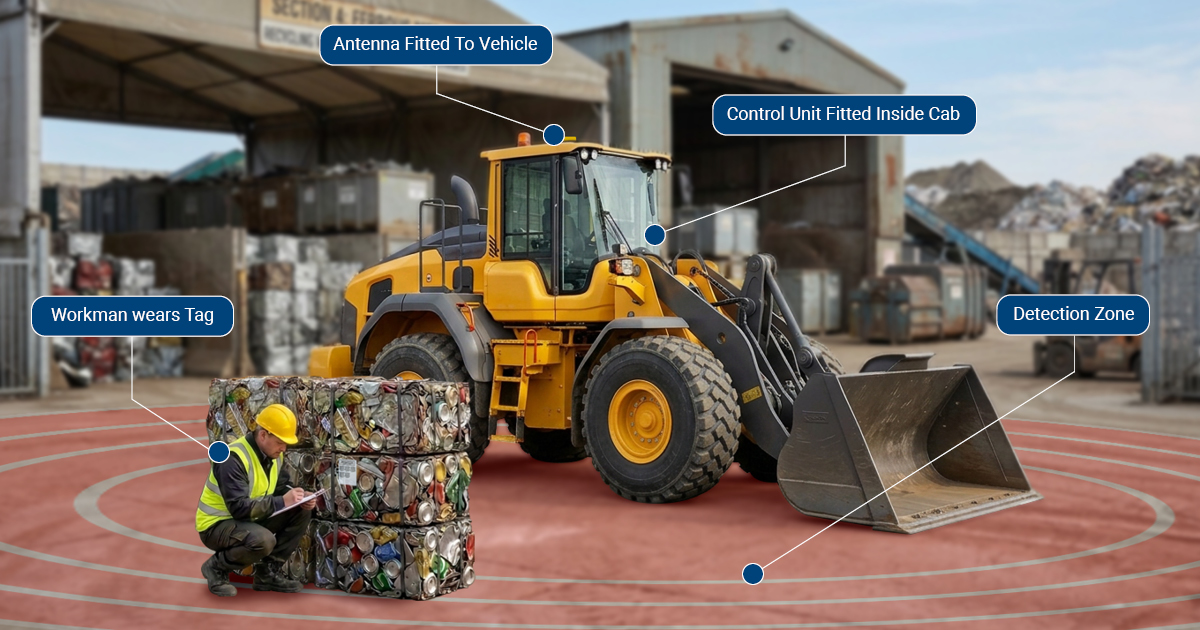
ZoneSafe V2P proximity warning system detects the workman (wearing a tag) even if he can’t be seen.
The Baseline: ZoneSafe Vehicle to Person Alert (V2P)
The foundation of smart tech pedestrian worksite safety is the ZoneSafe Vehicle-to-Person Alert (V2P) system. This proximity warning system uses Radio Frequency Identification (RFID) technology to establish an adjustable, invisible 360-degree detection zone around a vehicle.
Pedestrian workers carry a lightweight ZoneSafe RFID tag (which can be worn on a lanyard, placed in a pocket, or attached to a hard hat). At the same time, sensors and antennas are mounted directly to the vehicle. When a tagged worker enters the pre-configured detection zone around the vehicle (ranging up to 10 metres), the system activates an instantaneous, two-way alert. The vehicle operator receives audible and visual warnings inside the cab, while the pedestrian’s tag vibrates to warn them of the approaching vehicle.
The Strengths:
Non-Line-of-Sight Penetration: Because RFID signals penetrate solid objects, the ZoneSafe V2P system can detect workers hidden behind warehouse racking, around blind corners, or behind stacks of stored materials.
Radio frequency signals are completely unaffected by dark conditions, thick dust, blinding glare, or severe weather.
The Limitations:
The system is entirely dependent on the pedestrian wearing an active tag. If a visitor, delivery driver, or subcontractor steps onto the site without a tag, they remain completely invisible to the system.
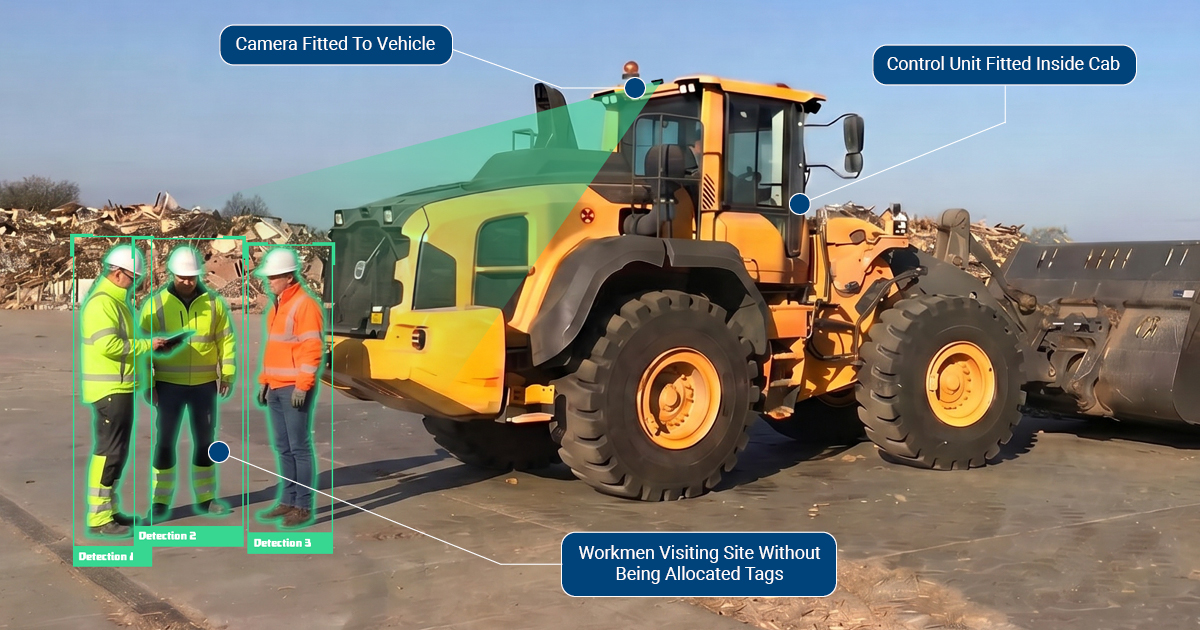
ZoneSafe HFR camera systems detect everyone on site, including all site visitors.
The New Entrant: ZoneSafe HFR (Human Form Recognition) AI Cameras
Representing the latest technology, ZoneSafe HFR Camera Detection Systems offer a completely tagless approach to safety. Unlike passive reversing cameras that merely project a video feed onto an in-cab monitor, HFR cameras utilise advanced artificial intelligence algorithms to scan the environment in real time. The integrated AI processes everything locally within the camera unit, instantly identifying the specific shapes and contours of the human form. The moment a person enters the camera’s field of view (fully adjustable from 0.5 to 25 metres), an immediate alert is delivered to the driver via the in-cab control unit, drastically reducing driver blind spot issues around the vehicle.
The Strengths:
Zero Tag Management: AI cameras automatically detect any human being instantly, making it an excellent choice for facilities with high pedestrian turnover, varying shift workers and site visitors.
Intelligent Mitigation: Because the AI distinguishes between a human and static environmental hazards (like traffic cones, walls, or pallets), it prevents unnecessary driver distractions.
The Limitations:
AI cameras are limited to what they can see. They can’t see through physical barriers such as product stacks or racking. If a worker steps out suddenly from behind an obstruction or around a blind corner, the camera cannot identify them until they physically step into the lens’s line of sight, which could be too late.
Pedestrian Safety Solution Evolution: The Power of Combined Technology
Choosing between the through-wall penetration of RFID and the tagless precision of AI cameras used to be a necessary compromise. Today, it no longer has to be. The ultimate development in industrial safety is the unified integration of ZoneSafe HFR Cameras and Vehicle-to-Person (V2P) Alert technology. Fusing these technologies creates an intelligent, multi-layered shield that delivers the highest standard of collision prevention available on the market.
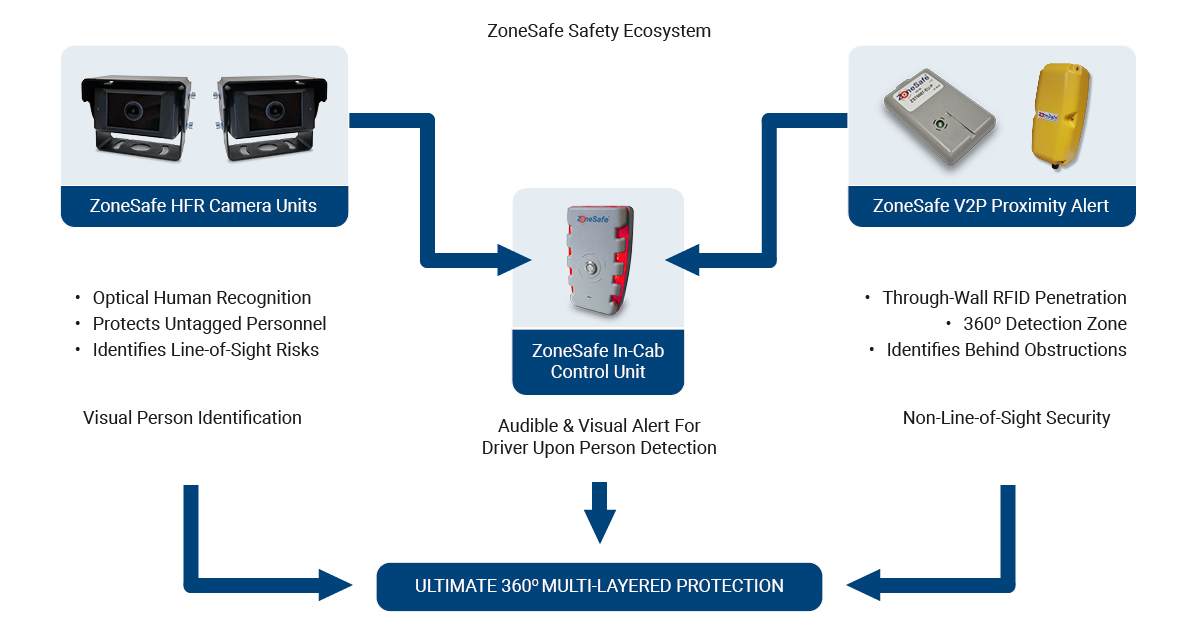
Failsafe Security for Tagged and Untagged Personnel
Your full-time, contracted staff will always have their wearable ZoneSafe RFID tags. However, modern industrial environments constantly interact with outside variables. The combined person detection system ensures that when an untagged delivery driver steps out of their truck, or a visiting supervisor walks the floor, the ZoneSafe HFR Camera acts as an important safety net, recognising them instantly.
Overcoming Line-of-Sight and Blind-Spot Hazards with Situational Awareness
A combined layout effectively closes the structural gaps of both technologies. If a worker is walking behind a blind corner or a stack of inventory, the ZoneSafe V2P system detects their tag through the obstruction and alerts the driver. When detected, the tag will continue to vibrate until it is out of the detection zone and the vehicle has moved away. This offers total situational awareness to both the vehicle operator and pedestrian worker.
Industry-Specific Impact: Where Combined Safety Matters Most
The combination of an HFR AI camera and V2P alert system can provide important protection across several high-risk sectors:
- Waste and Recycling: High-noise environments with massive blind spots both inside and out, where workers on foot constantly move around heavy shovel loaders, forklifts, excavators, and incoming commercial vehicles.
- Warehousing, Distribution and Logistics: Fast-moving environments characterised by tight blind corners with high racking, and busy forklift crossings, often where visibility can be severely restricted.
- Manufacturing, Paper, and Packaging: Production floors where heavy roll handlers such as forklift trucks transport bulky, sight-blocking loads near pedestrian walkways and narrow aisles.
- Ports and Construction: Expansive, rugged sectors where massive container handlers, reach stackers, and construction vehicles operate in large-scale moving environments. Environments are often dusty or dirty with reduced-light conditions, and operate with a high volume of transient contractors.
The Verdict: Achieving Zero Harm
Moving vehicles, pedestrian workers and site visitors must operate alongside each other to keep modern industry moving, but workplace accidents are entirely preventable. While AI cameras offer tagless detection, and a proximity warning system provides clever non-line-of-sight detection, relying on just one can create a potential vulnerability.
Don’t compromise your workforce’s safety. Whether you operate a bustling warehouse, a high-volume recycling plant, or a rugged port infrastructure, our safety experts are ready to show you how a unified system can protect your team.
See how ZoneSafe HFR AI Cameras and V2P proximity warning solutions seamlessly integrate to erase blind spots and prevent collisions on your specific worksite. More information on our range of AI camera systems can be found here. Get in touch via our Contact Us page, call 01202 868000 or email sales@zonesafe.com


