

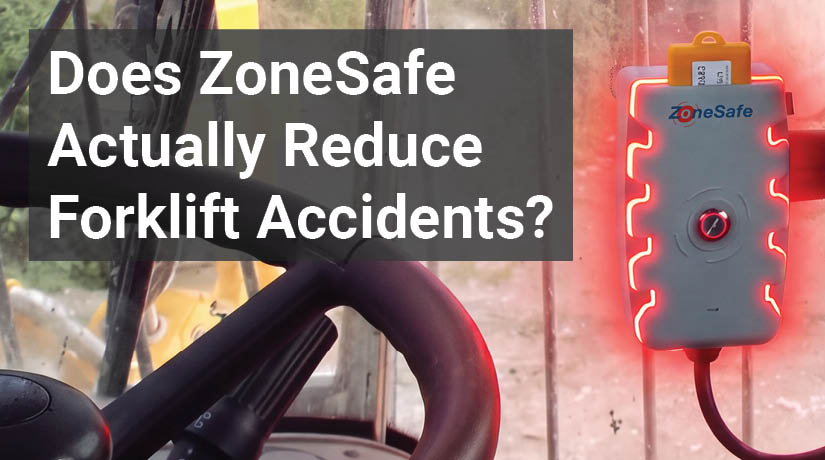
Does ZoneSafe actually reduce forklift accidents? Based on the available evidence, the answer is yes, in most deployments where tag compliance and zone configuration are properly managed. But anyone buying industrial safety technology without asking hard questions is not doing their job. As with all safety systems, proximity warning systems involve considerable initial cost. The stakes are high enough that “just trust us” is not an acceptable answer. What follows is a clear account of what the evidence on ZoneSafe actually shows, where the data is solid, where it is thin, and what you should demand before committing to any forklift pedestrian detection system or heavy vehicle proximity warning system.
ZoneSafe, developed by Avonwood Developments, has been in active commercial deployment across industrial sites since 2003, a start date the company documents in its own published materials. That is over two decades of real-world use across many sectors and environments, including warehousing, waste and recycling, ports, manufacturing plants, and logistics and distribution centres, to name a few. Longevity isn’t proof of effectiveness on its own, but a system which fails in the field doesn’t survive for twenty years. This article examines the technology honestly, weighs the evidence as it stands, and outlines the realistic limitations you need to understand before deciding how to reduce forklift accidents.
How ZoneSafe’s RFID detection system actually works.
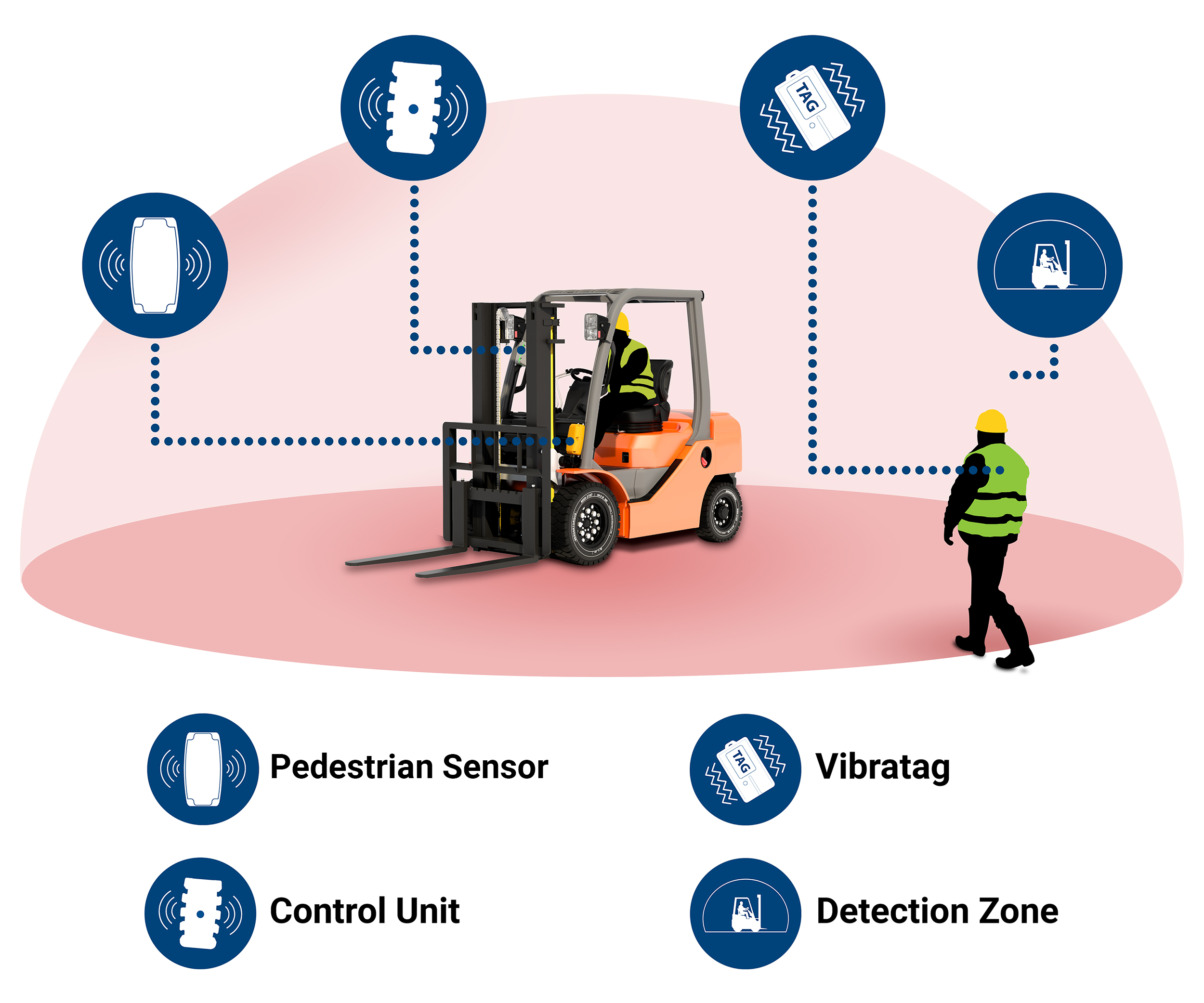
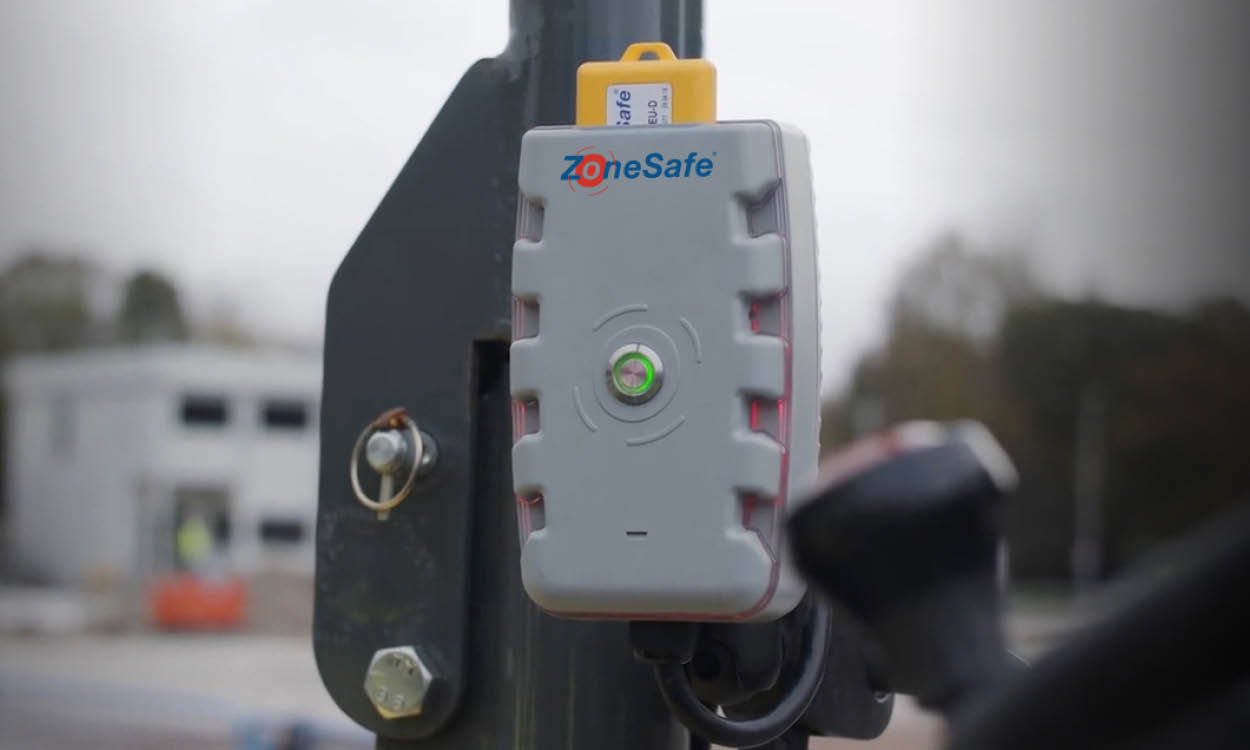
ZoneSafe is a tag-based RFID proximity warning system. Vehicle-mounted antennas create an invisible detection zone of typically 3 to 9 metres around a forklift or other industrial vehicle. When a pedestrian wearing an active RFID tag enters that zone, the system activates an alert. The detection does not require line of sight: the system reads tags through racking, walls, blind corners, and doorways. This directly addresses one of the most dangerous warehouse scenarios: a pedestrian stepping out from behind racking or a product pile into a moving vehicle’s path.
ZoneSafe’s warning alert system also matters because it offers two-way feedback for situational awareness. The forklift driver receives an audible and visual alert, while the pedestrian’s tag triggers a vibration alarm on their wearable device. Camera-based systems commonly focus alerts only on the vehicle operator. That bilateral warning is a meaningful operational difference, because a pedestrian who knows a vehicle is approaching can stop, change direction or make themselves visible from a distance rather than continuing to walk into danger.
The tag-based approach matters for false-alarm management. Because the system detects an RFID tag rather than trying to classify a moving object, identify a body part, or filter out environmental clutter such as passing pallets or racking, it tends to generate fewer false alarms. In a busy distribution centre, nuisance alarms are not just annoying; they undermine compliance and confidence. A team that starts ignoring alerts is in a worse position than a team with no system at all.
ZoneSafe can also reduce false alarms in specific areas when needed. For example, loading bay areas where multiple people may need to approach the forklift truck can trigger a false alarm if the truck isn’t moving. A ZoneSafe Q-Box can mask these areas, ensuring the alarm doesn’t go off.
Does ZoneSafe actually reduce forklift accidents? What the evidence shows.
No peer-reviewed, independently controlled trials in academic journals isolate ZoneSafe’s impact on forklift accident rates. That statement deserves to be said plainly. It is not unusual for industrial safety hardware: running a controlled trial in a live facility with real forklift traffic and pedestrians is practically difficult to organise and ethically complicated to run with a proper control group. Readers deserve to know the distinction between vendor-reported outcomes and independently verified data.
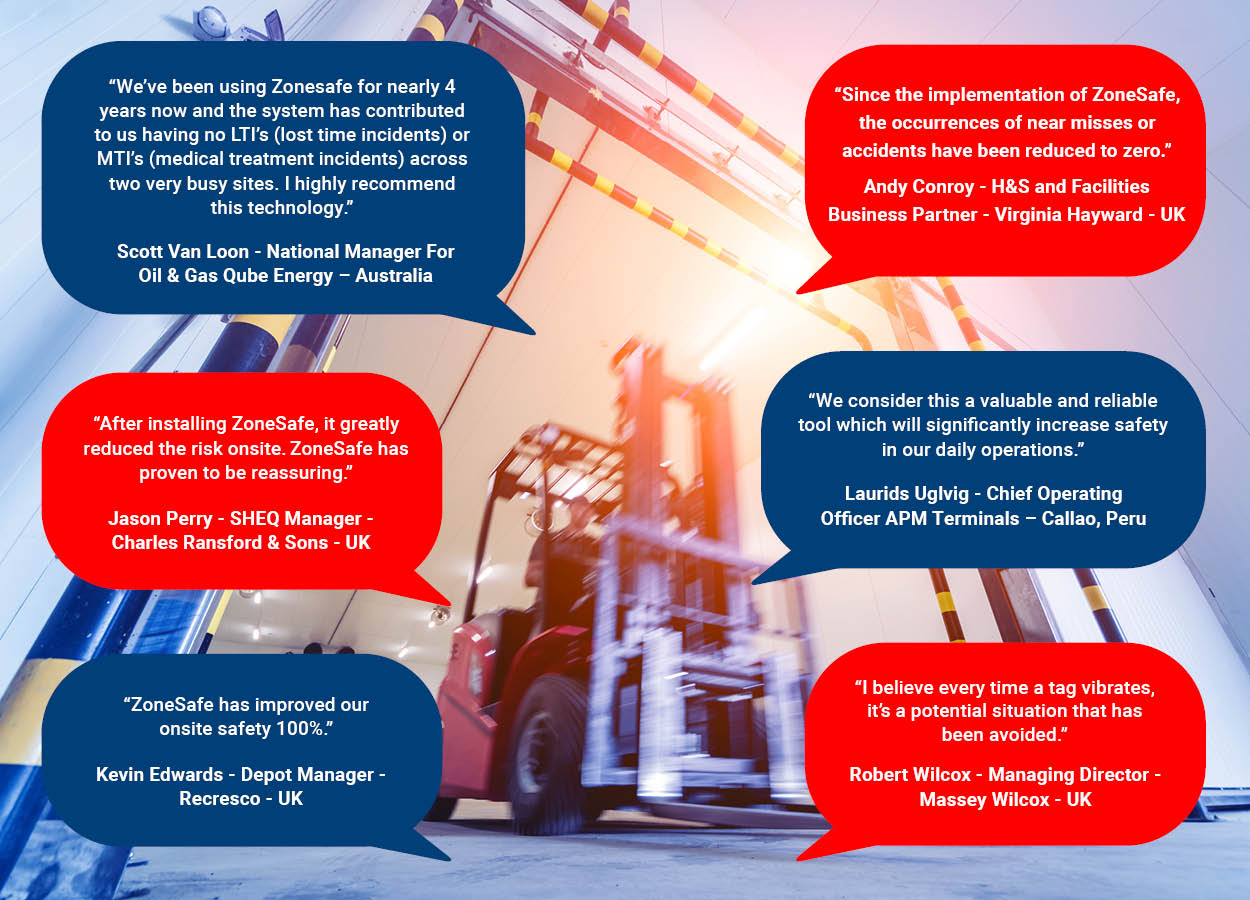
The strongest documented deployment in ZoneSafe’s publicly available evidence is the Qube Hamilton Port Operations trial, where the system was installed on three forklifts and evaluated against pre-agreed KPIs over a six-month period. The trial reportedly exceeded Qube Hamilton’s pre-agreed KPI thresholds. Peterson UK reported a dramatic decrease in activations over time, a meaningful indicator of behavioural change: when drivers and pedestrians learn where the risk zones are, they modify their behaviour to avoid them. Mondi and Virginia Hayward both reported improved pedestrian safety outcomes following implementation.
The leading report finding, that near misses and accidents were reduced to zero for some clients, comes directly from ZoneSafe’s testimonials and warrants both analysis and context. Zero near misses over a sustained period at an active industrial site is not a marketing fantasy if it is reported consistently across multiple deployments over multiple years. One client’s testimonial, published by ZoneSafe, reports, “no lost-time incidents or medical-treatment incidents across two busy sites over nearly four years” (Qube). That is an excellent operational outcome, even without a published control group. Wider industry data from UK deployment contexts suggests near-miss reductions of 50% to 82% in the months after installing forklift pedestrian detection technology, which is directionally consistent with what ZoneSafe’s client base reports.
How RFID compares with other forklift collision avoidance approaches.
Camera-based detection systems depend on line of sight and can struggle with conditions that are common in industrial environments: dust, glare, low light, and occlusion. A camera cannot see a pedestrian standing behind racking or stacks of product. LiDAR offers positional accuracy and easily detects untagged objects, but it tends to be the most expensive option on the market. If you need something that withstands harsh weather and dark environments, radar is a great alternative, even if its image resolution is a bit lower. The beauty of both systems is that they don’t rely on tags, meaning they can detect anyone in their path. In the end, there is no single right answer—the choice depends on your specific environment and budget.
RFID forklift safety systems excel when everyone wears a tag. Because the system triggers an alert the moment a tag enters the zone, you don’t need complex image processing, retraining AI models, or debating sensitivity settings. This simplicity reduces nuisance alarms and eliminates any need for recalibration. However, the most important point when comparing systems is that ZoneSafe’s non-line-of-sight capability protects areas where cameras fail, such as when a pedestrian suddenly steps out from behind a racking row directly into a forklift’s path. Detecting a pedestrian worker when they can’t be seen is invaluable.
Forms of physical segregation, like barriers, painted walkways, or exclusion zones, are the foundation of pedestrian-vehicle safety. Workplace transport guidance from the Health and Safety Executive (HSE) establishes physical measures as the essential first line of defence. Proximity warning systems do not replace these physical barriers; they build on them.
A ZoneSafe system adds an extra layer of protection on top of physical controls rather than replacing them. This distinction is crucial when building an internal investment case. The goal is not to choose between barriers or detection, but to combine them—because while a barrier defines a boundary, it cannot alert a driver if someone crosses into a hazardous area.
ZoneSafe also offers further layers of detection and protection. Vehicle-activated flashing signs, access control, warning lights, and floor projections all add further layers of safety and are worth investigating to mitigate risks on your worksite.
Real limitations that affect performance in the field.
Tag compliance is the system’s biggest dependency, and it is worth being direct about this. If a pedestrian is not wearing their tag, the system cannot detect them. This is not a technology flaw; it is a workforce compliance issue. Facilities with high staff turnover, shared tags, or inconsistent PPE culture will have gaps in coverage. The system performs as well as the habits built around it.
Active RFID tags have a finite operational life. ZoneSafe’s Vibratags are typically rated for two to three years, but can last much longer, depending on use. Replacement programmes need to be built into ongoing maintenance budgets rather than treated as an afterthought. In conditions with heavy RF interference or significant electromagnetic noise from nearby equipment, zone calibration can drift over time and require periodic adjustment. This is manageable, but it requires a maintenance schedule rather than a fit-and-forget assumption.
In crowded loading docks or busy pick aisles, forklifts and pedestrians are constantly working near each other. If your warning zones aren’t sized and positioned correctly, constant alarms will lead to alarm fatigue and cause workers to ignore them. That is why proper zone configuration is the most critical part of a successful setup. ZoneSafe handles this through a collaborative setup process—covering site discovery, zone definition, a custom proposal, and ongoing support. When choosing a system, don’t just ask how zones are validated before installation; ask how they are tested and verified after it is up and running.
Questions and metrics to request before committing to any proximity warning system.
Baseline KPIs
Establish your baseline before any deployment. Record your current near-miss rate, incident count, and if possible, the frequency of vehicle-to-person close calls by zone. Ask any system provider, including ZoneSafe, what KPIs they will track during a trial period and how they will report performance back to you. The Qube Hamilton trial used pre-agreed KPI thresholds measured over six months. That is the model to follow: agree the metrics before the system goes in, not after, so that outcome data has credibility.
Ask for a documented site-wide assessment rather than a generic product quote. Ask specific questions about detection zones and how the system will handle your particular blind spots, such as busy cross-aisles, shared loading bays, or pedestrian gates near reversing lanes. Remember, ZoneSafe can offer different system solutions, like activated signs and floor projections, for specific needs areas across your worksite. If a provider cannot answer these questions with site-specific detail, they are not ready to deploy in your facility.
Total cost of ownership
Remember that total ownership costs usually look quite different from your upfront expenses. If you manage a 10-vehicle fleet, you will want to account for ongoing details like tag replacements every couple of years; maintenance visits, including software updates and training sessions for new staff, may affect your long-term budget.
The financial return on preventing even a single major forklift-pedestrian accident is substantial. Industry estimates show that a serious incident can cost tens of thousands of pounds when you factor in workers’ compensation, legal fees, equipment damage, operational downtime, and investigations that result in large fines. Depending on how often incidents occur at your facility, you can recover the hardware investment per vehicle quickly. Be sure to calculate both the upfront purchase price and the three-year total cost of ownership before you present your business case to stakeholders.
The honest verdict on whether ZoneSafe reduces forklift accidents
The customer feedback on ZoneSafe is consistently positive. It covers over two decades of use across various industrial settings and on many different plant vehicles and industrial machinery. Warehouses, ports, and manufacturing plants, amongst others, have recorded clear drops in near-misses, with some sites reporting zero incidents over several years. While these findings come from specific sites and the manufacturer, no data contradict them.
So, does ZoneSafe actually reduce forklift accidents? In many deployments, it has, provided tag compliance and proper zone configuration are in place. The approach has supporting operational evidence across a wide range of industrial environments, though independent, peer-reviewed, ZoneSafe-specific trials are not yet available. Whether it will work in your environment depends on three things: your compliance culture around tag-wearing, the quality of your zone configuration at installation, and whether you structure the implementation as a properly measured trial with a defined baseline.
If you want to establish a baseline and run a structured trial, contact the ZoneSafe team directly. The consultative process is designed to start with your specific site risks, not with a generic product pitch, and that is exactly how a ZoneSafe proximity warning system investment should begin. Find out for yourself how ZoneSafe reduce forklift accidents – contact us today.