





What is a Proximity Warning System?
A Proximity Warning System is generally the term used for a system that warns industrial vehicles that they are in close proximity to a pedestrian worker. Most systems can be fitted to forklifts, reach stackers, gantry cranes, you name it – if these vehicles work near pedestrians, they need a warning system.
When accidents occur with a vehicle, pedestrians are the most at risk. Accidental collisions often occur when a pedestrian is not aware of a vehicle working close by. This is common in busy or loud working environments. The damage caused to a person by a forklift can often be severe, even fatal.
There are different choices for installing warning systems. Camera systems and spotlights are the cheapest types of ‘warnings’ for those working in close proximity to industrial vehicles, but these are not entirely reliable and not the best system if you require a complete managed solution.
A Proximity Warning System is more reliable
Zonesafe uses radio frequency identification (RFID) technology that creates detection zones around vehicles, assets, crossing points and walkways.
But what is RFID technology?
As Wikipedia states:
Radio-frequency identification (RFID) uses electromagnetic fields to automatically identify and track tags attached to objects. The tags contain electronically-stored information. Passive tags collect energy from a nearby RFID reader’s interrogating radio waves. Active tags have a local power source (such as a battery) and may operate hundreds of meters from the RFID reader. Unlike a barcode, the tag need not be within the line of sight of the reader, so it may be embedded in the tracked object.
So how does the ZoneSafe system work?
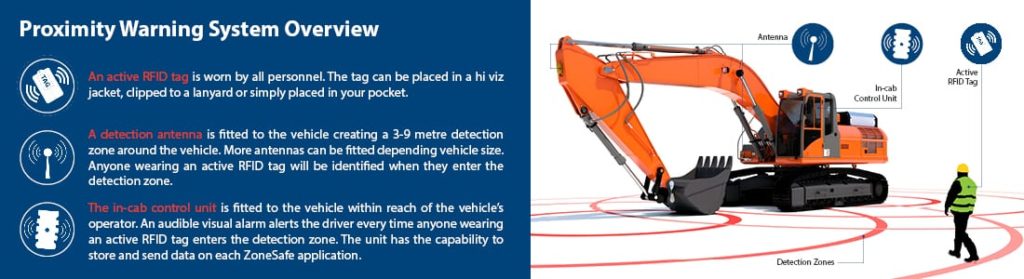
Active tags are worn by personnel, fitted to assets or setup around walkways, crossings and hazards. They are identified by a proximity sensor when entering the detection zone. This triggers an audible visual alert, warning vehicle operators of the tag’s close proximity to the vehicle. ZoneSafe tags do not require line of sight and will be detected regardless of obstructions, blind spots or poor visibility.
- 360 Degree Detection
- Single or Multiple Detection Zones
- 3-9 Metre Detection Range
- Detection Regardless of Obstruction
- Event Data and Logging
What is the process of getting ZoneSafe fitted?
- ZoneSafe active RFID tags are worn by all personnel or fitted to assets. The tag can be placed in our ZoneSafe hi viz jacket, clipped to a lanyard, placed in your pocket or fitted to a detection cone. Find out more here.
- A ZoneSafe detection antenna is fitted to the vehicle. This creates a 3-9 metre continuous detection zone around the vehicle, which detects personnel or objects carrying a ZoneSafe tag.
- A ZoneSafe in-cab control unit is fitted within reach of the vehicle’s operator. An audible, visual alarm alerts the operator every time a tagged person or object enters or breaks the antenna’s detection zone.
Find out more at ZoneSafe.com by clicking here.
Continue Reading
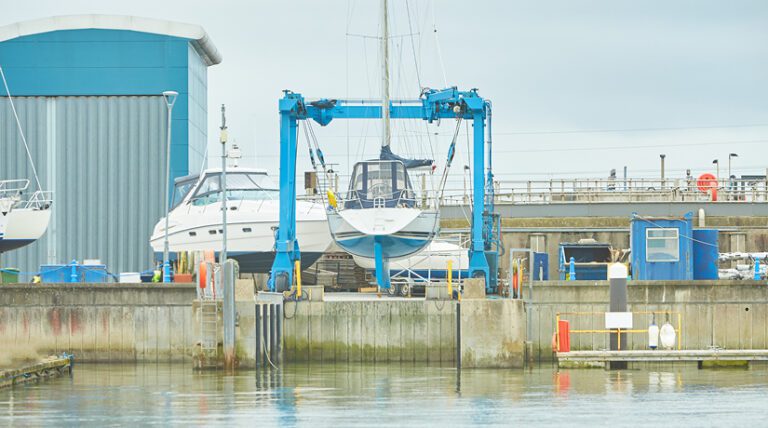
What Are The Best Active Signage Systems For a Marina?
Similar to any setting where vehicles and people interact closely, there are many risks around the marina environment. Heavy vehicles and cranes are often in…
Visit ZoneSafe at The Health & Safety Event
Our next exhibition this year comes at The NEC for The Health & Safety Event. This is a fantastic opportunity for you to explore the…

How to Improve Vehicle Safety In Your Waste Centre
Workplace transport accidents are one of the most common causes of serious injuries and fatalities in the waste management industry, and being struck by a…
Get in Touch
See how ZoneSafe can provide a solution for you Get in touch